Last update January 31, 2016
The description of the UHM Plant Project can be found under Plant Project Formulating. Each post will discuss one species showing a gallery about the particular tree or trees who served as the models for my artwork. Other photos and the art reproductions are to be presented with descriptive captions aiming to help get to know the personality of these creatures and tell a little bit about my artistic approach to them.
Let me introduce you to the gorgeous couple of uhm. 2371 & uhm. 2370!
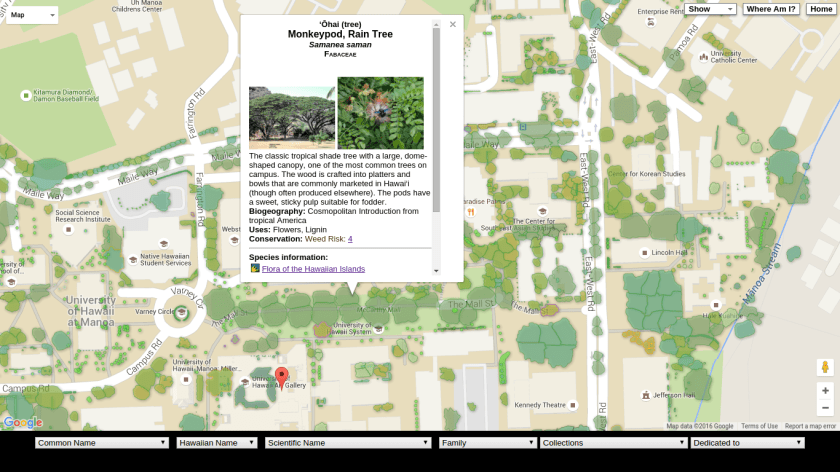
UHM Plantmap, showing the location of my studio also pointing at the monkeypod which is the right one on the artworks I made
Art & process


This first gallery of pictures show one particular couple of monkeypods on UH at Manoa. On each of these pictures the ones on the left can be identified by Plant ID: uhm. 2371, the one on the right, by Plant ID: uhm. 2370, which pieces of information also suggests that I was looking to the West when taking these photos, wandering around, trying to catch the greatest moment of sunset.
In this case, I was not sitting there making neither the painting nor the charcoal drawing (as that is also part of my process other times), but took photos for a few days around the same time. I used several different settings for the camera of my phone, and recorded voice notes to myself about how I imagine the future artworks representing them (giving myself instructions to pay attention to some specific details concerning colors, shapes and how these interact / how these two lovely trees interact with each other, what kind of illusion they give).
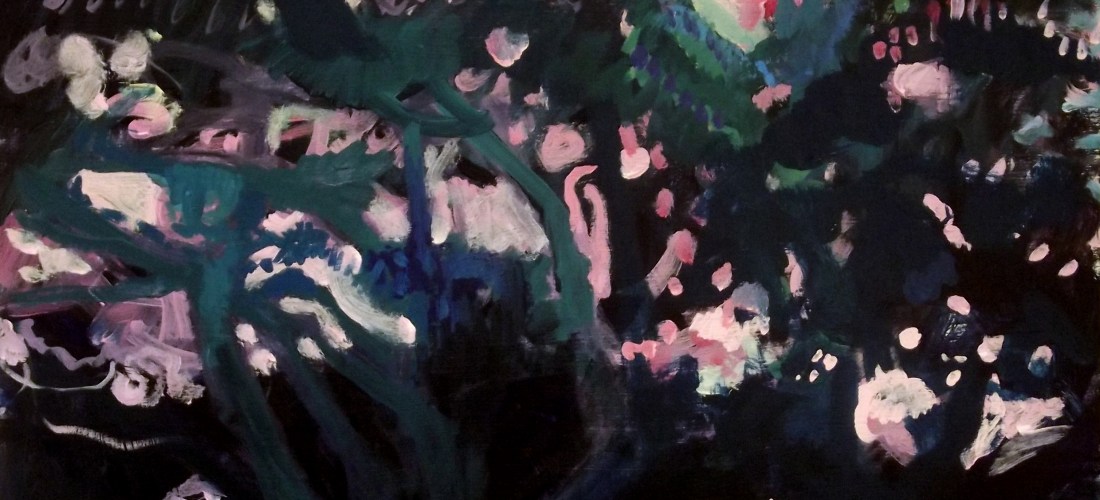
So having all these footage, each piece of it showing a particular aspect (a detail, a contrast of tones, a color set) of these trees, helped me create my interpretation in which I needed to make the charcoal first. Actually at the time, I felt like I need to loosen up a little bit in my expression, and so this pre-existing intention shows on this drawing above.
As for the painting, after a little time has passed, now I would say, it also must have had a slight influence on me that I found the books Wassily Kandinsky: Life and Work by Will Grohmann and Frank Kupka; pioneer of abstract art by Ludmila Vachtová. Around the same time the NEW NEW YORK: ABSTRACT PAINTING IN THE 21ST CENTURY has just been opened in the UH Art Gallery. The show itself and talks related to the exhibition discussed the variety of abstract paintings, and how it is obviously not a matter of a right or wrong path, to work on abstract or figurative artworks; also questioning if these are relevant terms in our post-postmodern world today anyhow. These thoughts were running through my head at the time.


Character of the ‘Ōhai (tree) / Monkeypod
a.k.a. Rain tree / Albizia saman


In this second gallery pictures of this tree type may be found, and visual info in order to get to know them.
Fun to know about this tree:
“The Rain Tree (…) is a large ornamental tree which can reach a height of 25 meters and a diameter of 40 meters (…). It has a thin, symmetrical, spreading crown which is beautiful in any park or garden setting (…) or as a pot plant (…).
The tree does cast shade (…), but rain can fall through its leaves on the area beneath the crown. This allows grass and other plants to grow up to its trunk (…) and makes for better landscapes. In contrast other trees often prevent rain from reaching the ground beneath their crowns and the result is unsightly bare soil.”
(Snippet of the introduction of the rain tree written by Professor Joseph Arditti and Mr.Mak Chin On)
For interesting info on the beautiful structure of the monkey pods, I checked out this description of the Maui Woodworker’s Guild.
— o —
Thank you, Roxanne Adams and David Strauch for the support, for your fabulous work at BGM in general and for your the cooperation! I would like to encourage everyone to comment below to improve the post and help me be accurate on the information I provide!
— o —
Sources listed as hyperlinks in the text and captions. A Plant Vocabulary is listed in a frequently updated post containing words which I needed when reading more detailed descriptions of these trees.
 @nbfeartist