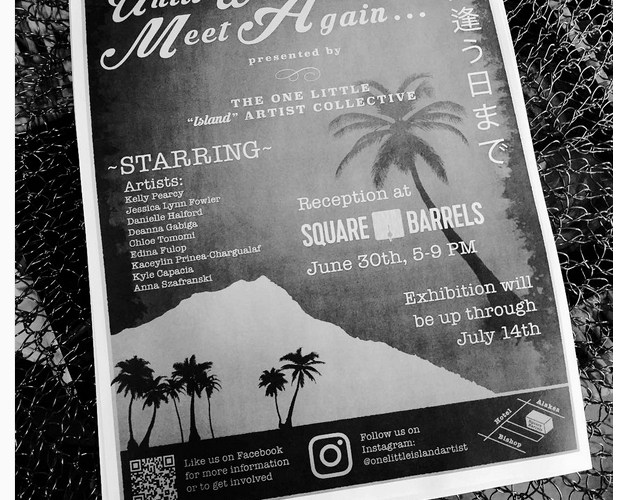
Save the date for June 30th for the Reception of The One Little “Island” Artist Collective @ Square Barrels!

Edina Fulop NBFE artwork, Edina Fulop NBFE event, Edina Fulop NBFE featured news

I would like to cordially invite you to a group exhibition I am participating in with The One Little “Island” Artist Collective at Square Barrels. The originally Michigan-based group grew when members moved to Hawaii, still some members currently living on the Mainland or soon-to-be-off-the-island are to be represented at this show also.

My good friend fiber and metalsmith artist Deanna Gabiga introduced me to this colorful, young creative group of people who work in a wide range of media. Deanna—whose work is especially of a truly exceptional kind that is definitely worth getting to know and see in person—and I have a lot in common concerning our interest in different cultures and how our lifepaths brought us to very interesting places of the world. I got to know her as a very talented, driven and clever woman. We have our regular sessions where we consult with each other concerning art, Hawaii and share our experiences and opinions.

I am thankful that on one of our meetings she invited me to exhibit with this group to show a series of my smaller pieces I created during my Artist Residency at University of Hawaii at Manoa during the past academic year. As far as my work, this show in the downtown area of Honolulu can be considered as a little sneak peek of the body of work that will be shown at another two-person show I will soon announce.


———- 000 ———-

The One Little “Island” Artist Collective presents:

“Until We Meet Again”

The What: an art exhibition featuring ten artists based in
Hawaii and continental US.

The Where: Square Barrels in downtown Honolulu, Hawaii
1001 Bishop Street in Bishop Square.
The When: opening reception on June 30th, 5pm-9pm,
with exhibition running through July 14th.

Starring:

Kelly Pearcy
Kyle Capacia
Jessica Lynn Fowler
Edina Fülöp
Deanna Gabiga
Danielle Halford
Brandi Hardy
Kaceylin Prinea-Chargualaf
Anna Szafranski
Chloe Tomomi

…be there, or be square (pun definitely intended).

———- 000 ———-

For more info see the public facebook event.
https://www.instagram.com/p/BG7_nbQEdmf/

The Retrieval of the Beautiful @ The Painting Center

Edina Fulop NBFE artwork, Edina Fulop NBFE event, Edina Fulop NBFE featured news

Check out the newsletter and The Retrieval of the Beautiful catalogue!


“Exhibition Dates: June 21 – July 16, 2016

Deadline for Submission: May 6, 2016

Notification Date: May 20, 2016

Artwork Shipping Dates: June 14 – June 18, 2016

Opening Reception: Thursday, June 23, from 6 – 8 pm”

from http://thepaintingcenter.org/juried-exhibition-retrieval-beautiful


“The Retrieval of the Beautiful
Galen Johnson’s book The Retrieval of the Beautiful (Northwestern University Press)
is a dynamic discussion of existence and consciousness of human activity, including
art. Johnson writes, “Here it is enough to see that beauty and the sublime blend into
one another when the beautiful grows powerful, transcendent and majestic.” Something
beautiful seduces you and draws you in.
Galen A. Johnson is an honors professor at the University of Rhode Island, director of
the Rhode Island Center for the Humanities, and General Secretary of the International
Merleau Ponty Circle. We are grateful to Galen Johnson and Northwestern University
Press for the use of the title The Retrieval of the Beautiful, the title of their recent
publication. Maurice Merleau Ponty trained as a psychologist, one of the youngest to
lecture at the Sorbonne and was an editor at Les Temps Modernes with Jean Paul
Sartre.
Merleau’s philosophical writing emerges from a deeply engaged humanist personality and
a passionately motivated form of observation. Merleau’s contribution to Phenomenology
is, for us, partly located in his description and analysis of what we might categorize as,
“formal” painterly issues – complementary color relations, parallax vision, afterimages,
geometry of optics.
His seminal essay, “Cezanne’s Doubt”, links these formalist elements to Cezanne’s
psychology and the artist’s fierce insistence on perception as a lived, physical
phenomenon. The essay was part of his articulation of the idea of the body-subject as
an alternative to the Cartesian ‘Cogito’. The notion of “embodiment” is a central tenet
of his ontology.
The development of art since the 1970’s has been, in many ways, Phenomenological.
It has taken many of the connections between body and expression, temperament
and politics and finally body-art-history and made it its own. Through the framework
of Merleau’s aesthetics Galen Johnson pursues the connections found in desire and
repetition, difference and rhythm as they evoke the sublime. Johnson’s finely textured
discussion weaves classical philosophy as well as the moderns, including Deleuze
and Lyotard, as they shuttle threads in
The Retrieval of the Beautiful.”
Bill Hochhausen, 2016 from the catalogue

Breaking News: work accepted for show at the Painting Center in NY

Edina Fulop NBFE artwork, Edina Fulop NBFE event, Edina Fulop NBFE featured news

I am pleased to announce that my work has been been selected to be part of The Painting Center’s Retrieval of the Beautiful exhibition. The exhibition will feature 84 artists. The dates for the exhibition are June 21 – July 16, 2016. The Opening Reception is Thursday, June 23 from 6 to 8 pm.

This highly competitive opportunity gives me the chance to represent my art in Manhattan for the first time. More information on the particular piece which has been framed and shipped lately and just been delivered, soon to be published.

I would like to grab every platform to express how grateful I am for my academic year long Artist Residency offered by the Head of Art Department at University of Hawaii at Manoa, wonderful artist and person Gaye Chan and to Reem Bassous professor and truly inspiring, amazing artist who brought my attention to the call of this show.

Having my studio at UH Manoa has been a blessing in so many senses, I hope I have been able to give some of it back to the community.

The gigantic Tree of Life, the Baobab

Edina Fulop NBFE UHM Plant Project

Baobab aka dead-rat tree, monkey-bread tree, upside-down tree / Adansonia digitata, Plant ID: uhm. 0042

This particular tree is listed as exceptional tree on the UH plantmap and it is exceptional indeed. 🙂

As the different names suggest, ‘the baobab tree is steeped in a wealth of mystique, legend and superstition’. [1] ‘Baobab is capable of providing shelter, clothing, food, and water for human inhabitants and animals of the African Savannah regions. The cork-like bark or huge stem is fire resistant and is used for making cloth and rope. The leaves are used as condiments and medicines. The Baobab fruit, sometimes called ‘monkey bread’, rich in vitamin C and eaten by African locals.’ [1] [7]

The trunk of this giant, native to Africa, ‘tends to be bottle-shaped and can reach  an impressive diameter of 10-14 m and the tree can reach a height of 25 m, the height of a 5 story building.’ [3] Meaning the examples below may be even huge for this species, still the smallest one is enormous too. 🙂

The captions for the pictures in the album below describe a lot more interesting, visually more easily comprehensible info of the plant and after some scrolling you may read a little about my work method also.


Let me also show you a little fun intro video on the 6000-year-old (no mistake with number of zeros!) largest baobab ever, located in South Africa, which also has some specialty worth discovering! 😉 [5]

As for the way I approached this gigantic tree…

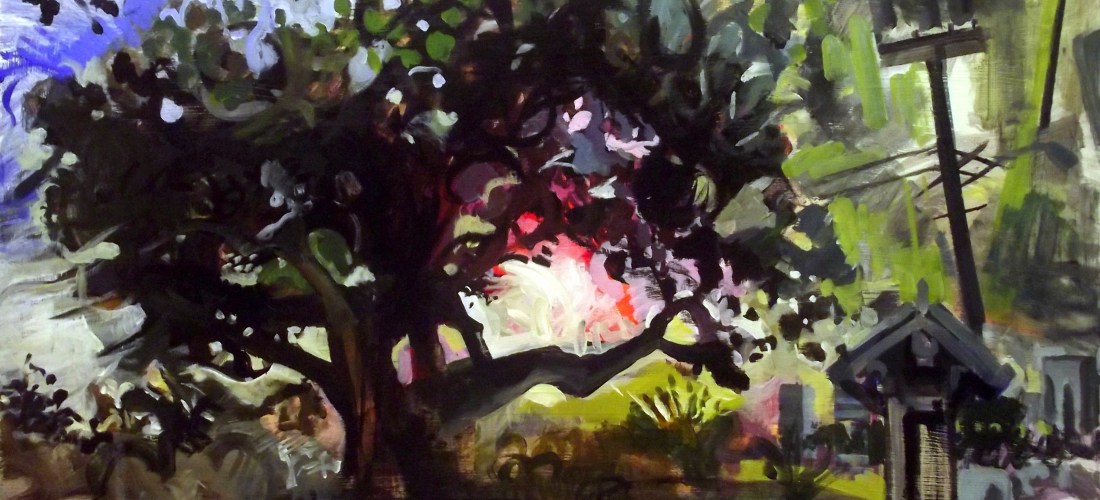
I first made a piece using a structural way of thinking where I could show the scale of the tree and the Art Building behind it. (For UH people this piece of info I found online might be interesting: ‘[this particular] tree was there first, and in fact is the oldest tree on campus. Before the art building, this tree shaded Gilmore Hall, built in 1935 and demolished in 1973.’ Though knowing the time it usually takes a baobab to grow so huge what happened in the past century just seems like an unnecessary detail. 🙂 Also how interesting it is to think about how small we are not just literally, (see featured photo above for scale), but figuratively speaking also comparing us to a wise, old tree like that…  [6]) Back to the paintings… I actually used white wallpaint mixed with sumi ink there, which combined the characteristics of the two by being thick and having the ability to cover, also the shade of grey I was looking for. I went out to do some sketches that day with my 9.5 by 10.7 inch-big little cardboards and I just felt there is no way of showing the power of this plant in its full value by making a composition of the full tree on this small piece. This is why I used two different cut-outs on the two paintings I made. One focusing on the crown and one on the trunk. So this occasion was about working in situ. The second one is more sophisticated, aiming to give an impression of the foliage. I used similar technique on another piece also of another tree in the Downtown of Honolulu, that I had done previously.

As it is becoming clearer to me as the time goes by I am unconsciously looking for the circumstances appearing in the late afternoon hours, so the latter baobab version was also done in the same session before sunset. This also means I worked quickly, which is kind of typical for me, with exceptions of course. Still I would say the dynamic fashion of work describes my method quite precisely even if I work on a bigger piece, for a longer time.

Still I feel I will have to revisit the subject matter. 🙂

I hope you like the rich character of this tree.


[1] Hankey, Andrew (February 2004). “Adansonia digitata A L.”. plantzafrica

[2] https://en.wikipedia.org/wiki/Pachycaul, Hungarian version of the Wikipedia article with slightly different content

[3] “Baobab (Adansonia digitata) – Information on Baobab – Encyclopedia of Life”. Encyclopedia of Life. Marie Anne Rolufs, Oregon State University, last download March 4, 2016

[4] Photo of a baobab and the Edina Fulop at Foster Botanical Garden in Honolulu taken by author of cserelatogatohawaiion.blogspot.com, researcher and husband Sandor Gobi, last download Feb 17, 2016 from http://cserelatogatohawaiion.blogspot.com/2016/01/foster-botanikus-kert.html

[5] http://adventureswithben.com/landmarks/giant-baobab-tree/, direct link to video uploaded to youtube, last download March 4, 2016

[6] http://www.edohawaii.com/baobab/uh.html, last download March 4, 2016

[7] http://www.powbab.com/pages/baobab-tree, last download March 4, 2016

[8] http://plantpono.org, last download March 4, 2016

[9] http://www.botany.hawaii.edu, last download March 4, 2016

Open Studio// Potluck// Bday/nameday Party

Edina Fulop NBFE event

Dear Reader,

if you are currently in Honolulu, I would like to invite you and your partner to my open studio.

Check out event Open Studio// Potluck// Bday/nameday Party at studio #204, Art Dept, University of Hawaii at Manoa this Saturday to see the latest works in situ and have a nice time among UH people, artists and open-minded non-artist friends!

The event welcomes anyone interested!

See you,

NBFE

12504179_1558214741156987_1813535649_n

Breaking News: Residency extended!

Edina Fulop NBFE featured news

I am unbelievably happy I can announce my Artist Residency at University of Hawaii at Manoa being extended until the very end of May which turns my stay here into a roughly 8 month-long paradise in a professional sense. 🙂

This means I can use this fabulous opportunity to continue my own research as an artist, use my studio (#204, Art Building), get to know these talented Honolulu-based artists (whose artistic work and activity as professors, lecturers are both deeply inspiring) and widen my pedagogical experiences by having classes over my studio.

It would all not be possible without the help and support of the Art Department, primarily conceptual artist and head of the department Gaye Chan! I would like to thank also the faculty for being so open, cooperative and supportive!

My studio occupancy started on Oct 5 2015 and, according to the latest notification I received, lasts until May 31, 2016.


on masonite

The Friendly Monkeypods

Edina Fulop NBFE UHM Plant Project

Last update January 31, 2016

The description of the UHM Plant Project can be found under Plant Project Formulating. Each post will discuss one species showing a gallery about the particular tree or trees who served as the models for my artwork. Other photos and the art reproductions are to be presented with descriptive captions aiming to help get to know the personality of these creatures and tell a little bit about my artistic approach to them.

Let me introduce you to the gorgeous couple of uhm. 2371 & uhm. 2370!

intro-plantmap

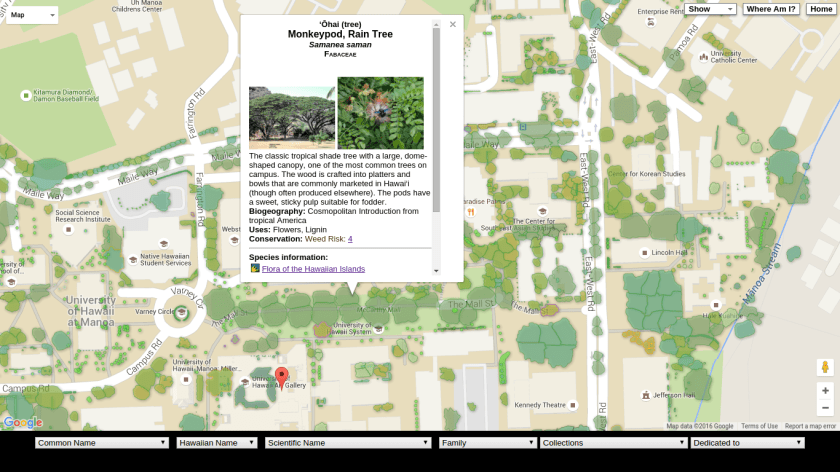
UHM Plantmap, showing the location of my studio also pointing at the monkeypod which is the right one on the artworks I made

 Art & process


This first gallery of pictures show one particular couple of monkeypods on UH at Manoa. On each of these pictures the ones on the left can be identified by Plant ID: uhm. 2371, the one on the right, by Plant ID: uhm. 2370, which pieces of information also suggests that I was looking to the West when taking these photos, wandering around, trying to catch the greatest moment of sunset.

In this case, I was not sitting there making neither the painting nor the charcoal drawing (as that is also part of my process other times), but took photos for a few days around the same time. I used several different settings for the camera of my phone, and recorded voice notes to myself about how I imagine the future artworks representing them (giving myself instructions to pay attention to some specific details concerning colors, shapes and how these interact / how these two lovely trees interact with each other, what kind of illusion they give).

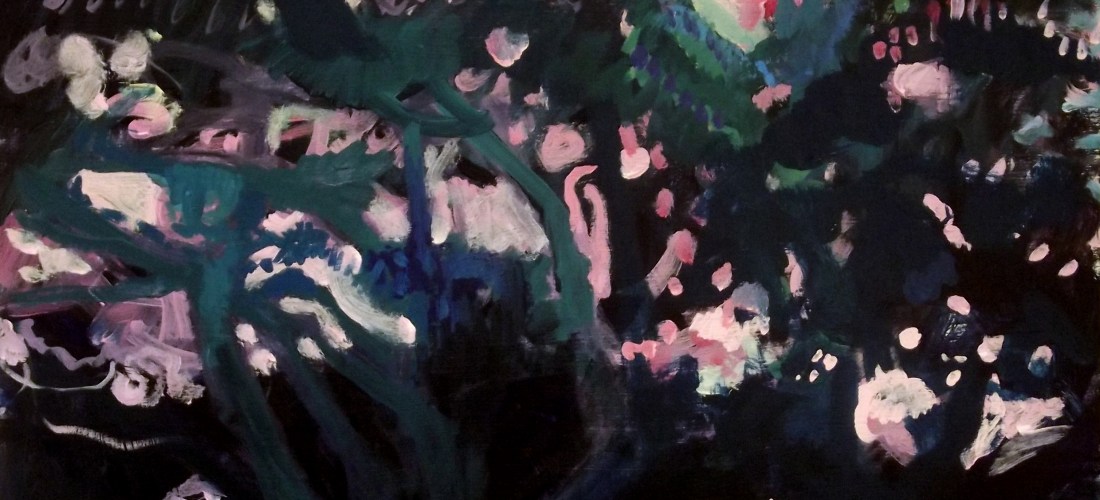
So having all these footage, each piece of it showing a particular aspect (a detail, a contrast of tones, a color set) of these trees, helped me create my interpretation in which I needed to make the charcoal first. Actually at the time, I felt like I need to loosen up a little bit in my expression, and so this pre-existing intention shows on this drawing above.

As for the painting, after a little time has passed, now I would say, it also must have had a slight influence on me that I found the books Wassily Kandinsky: Life and Work by Will Grohmann and Frank Kupka; pioneer of abstract art by Ludmila Vachtová. Around the same time the NEW NEW YORK: ABSTRACT PAINTING IN THE 21ST CENTURY has just been opened in the UH Art Gallery. The show itself and talks related to the exhibition discussed the variety of abstract paintings, and how it is obviously not a matter of a right or wrong path, to work on abstract or figurative artworks; also questioning if these are relevant terms in our post-postmodern world today anyhow. These thoughts were running through my head at the time.


Character of the ‘Ōhai (tree) / Monkeypod

a.k.a. Rain tree / Albizia saman

In this second gallery pictures of this tree type may be found, and visual info in order to get to know them.

Fun to know about this tree:

“The Rain Tree (…) is a large ornamental tree which can reach a height of 25 meters and a diameter of 40 meters (…). It has a thin, symmetrical, spreading crown which is beautiful in any park or garden setting (…) or as a pot plant (…).

The tree does cast shade (…), but rain can fall through its leaves on the area beneath the crown. This allows grass and other plants to grow up to its trunk (…) and makes for better landscapes. In contrast other trees often prevent rain from reaching the ground beneath their crowns and the result is unsightly bare soil.”

(Snippet of the introduction of the rain tree written by Professor Joseph Arditti and Mr.Mak Chin On)

For interesting info on the beautiful structure of the monkey pods, I checked out this description of the Maui Woodworker’s Guild.

— o —

Thank you, Roxanne Adams and David Strauch for the support, for your fabulous work at BGM in general and for your the cooperation! I would like to encourage everyone to comment below to improve the post and help me be accurate on the information I provide!

— o —

Sources listed as hyperlinks in the text and captions. A Plant Vocabulary is listed in a frequently updated post containing words which I needed when reading more detailed descriptions of these trees.


Plant Vocabulary

Edina Fulop NBFE featured news
Frequently being updated in connection with the UHM Plant Project, gathering more and more words from the field of flora, biology, plants etc. that are not necessarily part of a person’s vocabulary who learns English.
Last update January 31, 2016
genusnoun, [ˈjēnəs] a principal taxonomic category that ranks above species and below family, and is denoted by a capitalized Latin name, e.g., Leo. “The identification of two named genera in a single organism presents a taxonomic dilemma.” synonyms: subdivision, division, group, subfamily

heartwoodnoun, [ˈhärtˌwo͝od] the dense inner part of a tree trunk, yielding the hardest timber. “In the inner heartwood , these bodies were rarefying and cell walls became impregnated by a brown colour.”


ligninnoun, [ˈlignin] a complex organic polymer deposited in the cell walls of many plants, making them rigid and woody. “Callose, lignin and suberin are polymers that can be elicited as plant defences that reinforce cell walls of some species.”

podnoun, [päd] an elongated seed vessel of a leguminous plant such as the pea, splitting open on both sides when ripe. “Late in the season, just as the seedpods begin to split, open a pod and gather the seeds.” synonyms:  shell, husk, hull, case, shuck, pericarp, capsule

sapwoodnoun, [ˈsapˌwo͝od] the soft outer layers of recently formed wood between the heartwood and the bark, containing the functioning vascular tissue. “The beetles lay their eggs in trees and the resulting larvae bore into the wood, feeding on the tree’s cambium, sapwood , and heartwood and impeding the movement of water and nutrients through the tree.”

Definitions from Google Translate unless indicated otherwise.

Ongoing Artist Residency from Oct 2015

Edina Fulop NBFE featured news

Last update Jan 28, 2016

I am honored to have been offered a position as artist-in-residence by conceptual artist and head of University of Hawai’i at Manoa – Art Department, Gaye Chan, along with an individual studio (#204) for the rest of the semester starting from Oct 5, 2015. After arriving to Hawaii at the end of August I made some sketches walking around Honolulu and going on some trips around Oahu, but for the majority of my new pieces to be created I definitely needed a space, which I actually got to start using in perfect timing.

Since the University of Hawaii at Manoa is a wonderful campus I felt like the only legit thing to do is to continue focusing on the plants in Honolulu concerning my work (though previously I had been engaged in charcoal portraits). The department has been the most supportive possible introducing me on their official site, reporting my activity on social media.


Edina Fülöp – artist in residence – has only been in house for a day and she has already settled right in and got to work!! more info on her at http://www.hawaii.edu/art/news+updates/?p=1253

Posted by University of Hawaii at Manoa – Department of Art and Art History on Sunday, October 4, 2015


My work here exceeds studio work in a sense that I have been having studio visits quite often. Beside consulting with BFA and MFA students, looking at their work, listening to their presentations, I have been having them in my studio individually, and whole classes have been coming to my studio while I represented my artwork to them. Sometimes one theme has been in focus like drawing with charcoal in which case I have been making demonstrations for them, also interacting with their drawing sessions by helping them with my advices.

This whole chain of events happened encouraged by Gaye Chan, and thanks to the open-minded attitude of UH Art Dept professors like abstract painter Debra Drexler, artist Wendy Kawabata and printmaker & MFA student / Graduate Assistant Hannah Hilary Day.

I have been having a lot of fun while experiencing how inter-cultural the language of visual art is. I am fortunate enough to have a lot on my plate concerning future interactions with the art scene in Honolulu, which I am going to share in details in due time. About my ongoing project concerning the plant life more info can be found under Plant Project Formulating.

The subject of the time period of my residency was revisited and am super happy about it being extended until at least Feb 10, 2016.

Studio Warming Reception

Edina Fulop NBFE event

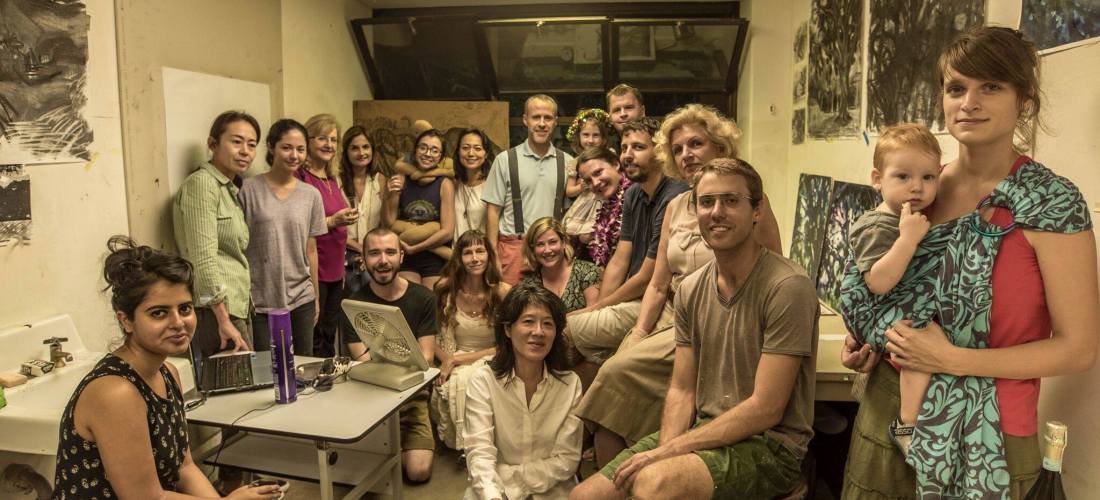
I am truly happy for finding out that the Hungarian people in Honolulu makes such a lively community here, open to art and interested in seeing contemporary pieces. I have made good friends with marketing guru Agnes Rennie and private chef Zoltan Kiss who threw me the fantastic event, called ‘Studio warming reception for artist Edina Fulop’ on Nov 5, 2015.

The combination of the studio atmosphere, the delightful company that got together (including professionals and non-professional art-lovers) and the extremely sophisticated and delicious hors d’oeuvres made a joyful evening. Special thanks for the photos taken by professional photographer Andi Lilikoi.

I am very grateful for the great number of people attending this soirée.


“(…) Since Oct 2015 I am working in my studio on the campus as artist in residence. With the help of my dear local Hungarian friends a reception connected to a studiovisit was held where my new artist friends came and I could show my works to the Hungarian community. Further cooperation is in process with the University in a pedagogical sense. Classes have scheduled visits in my studio and vice versa, I help them in their drawing classes, and I also visit studios of MFA students here. In the foreseeable future I would like to present my works in a solo exhibition. (…)
Posted by NBFE.artist on Thursday, November 19, 2015


Kis osszefoglalo az elmult esemenyekrol. Short report on recent events.

Posted by Edina Fülöp on Thursday, November 19, 2015