Baobab aka dead-rat tree, monkey-bread tree, upside-down tree / Adansonia digitata, Plant ID: uhm. 0042
This particular tree is listed as exceptional tree on the UH plantmap and it is exceptional indeed. 🙂
As the different names suggest, ‘the baobab tree is steeped in a wealth of mystique, legend and superstition’. [1] ‘Baobab is capable of providing shelter, clothing, food, and water for human inhabitants and animals of the African Savannah regions. The cork-like bark or huge stem is fire resistant and is used for making cloth and rope. The leaves are used as condiments and medicines. The Baobab fruit, sometimes called ‘monkey bread’, rich in vitamin C and eaten by African locals.’ [1] [7]
The trunk of this giant, native to Africa, ‘tends to be bottle-shaped and can reach an impressive diameter of 10-14 m and the tree can reach a height of 25 m, the height of a 5 story building.’ [3] Meaning the examples below may be even huge for this species, still the smallest one is enormous too. 🙂
The captions for the pictures in the album below describe a lot more interesting, visually more easily comprehensible info of the plant and after some scrolling you may read a little about my work method also.
![Baobab in Africa suggesting why the plant is also named 'upside-down tree', hence the rootlike branches [3]](https://i0.wp.com/nbfeartist.com/wp-content/uploads/2016/03/07742_580_360.jpg?w=276&h=276&crop=1&ssl=1 "07742_580_360")
![A shot of the edible ripe fruit of this plant, which explains the 'monkey-bread tree' naming [1]](https://i0.wp.com/nbfeartist.com/wp-content/uploads/2016/03/adansondigit2.jpg?w=276&h=276&crop=1&ssl=1 "adansondigit2")
!['The fruit can be up to 25 centimetres (10 in) long and is used to make a drink' [2] [3] 'The scientific name Adansonia refers to the French explorer and botanist, Michel Adanson (1727–1806), who discovered it in 1749 on the island of Sor, Senegal.' [6] On the nearby Îles des Madeleines Adanson found another baobab, 3.8 m in diameter, which bore the carvings of passing mariners on its trunk dated as early as the 1444. (...) Adanson concluded that the baobab, of all the trees he studied, >>is probably the most useful tree in all.<< He consumed baobab juice twice a day, while in Africa. He remained convinced that it maintained his health for him.[7]](https://i0.wp.com/nbfeartist.com/wp-content/uploads/2016/03/baobab_frucht.jpg?w=276&h=276&crop=1&ssl=1 "Baobab_Frucht")
!['>>Digitata<< refers to the digits of the hand. The baobab's compound leaves with normally five (but up to seven) leaflets are akin to a hand.' [1] Adansonia digitata - Baobab Tree, Dead-rat tree, Monkey-bread tree, Upside-down tree or Gorakha Chinch in Sanjeevaiah Park, Hyderabad, India [2]](https://i0.wp.com/nbfeartist.com/wp-content/uploads/2016/03/adansonia_digitata_baobab_tree_in_hyderabad_w_img_8271.jpg?w=276&h=276&crop=1&ssl=1 "Adansonia_digitata_(Baobab_Tree)_in_Hyderabad_W_IMG_8271")
![its pretty flower [1]](https://i0.wp.com/nbfeartist.com/wp-content/uploads/2016/03/adansondigit3.jpg?w=276&h=276&crop=1&ssl=1 "adansondigit3")
![the fruits of the baobab which in my understanding are responsible for the naming 'dead-rat tree' :) [3]](https://i0.wp.com/nbfeartist.com/wp-content/uploads/2016/03/50607_orig.jpg?w=276&h=276&crop=1&ssl=1 "50607_orig")
![another example for rat-resembelance :) [7]](https://i0.wp.com/nbfeartist.com/wp-content/uploads/2016/03/bfcs_6-001_large.jpg?w=276&h=276&crop=1&ssl=1 "bfcs_6-001_large")
![nice shots of baobabs [7]](https://i0.wp.com/nbfeartist.com/wp-content/uploads/2016/03/img_8576_large_large.jpg?w=276&h=276&crop=1&ssl=1 "IMG_8576_Large_large")
![another example for the baobab [7]](https://i0.wp.com/nbfeartist.com/wp-content/uploads/2016/03/bfcs_12-001_large.jpg?w=276&h=276&crop=1&ssl=1 "bfcs_12-001_large")
Let me also show you a little fun intro video on the 6000-year-old (no mistake with number of zeros!) largest baobab ever, located in South Africa, which also has some specialty worth discovering! 😉 [5]
As for the way I approached this gigantic tree…


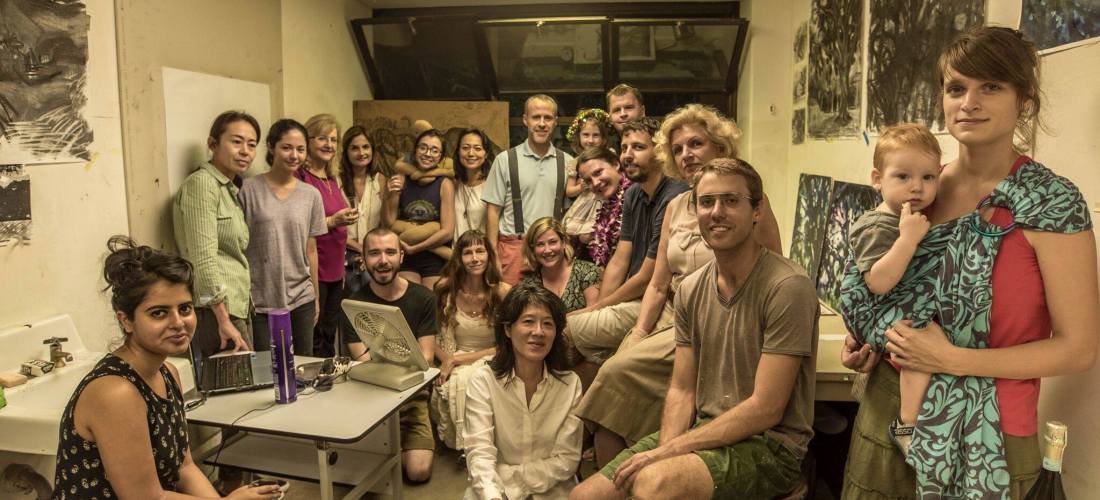
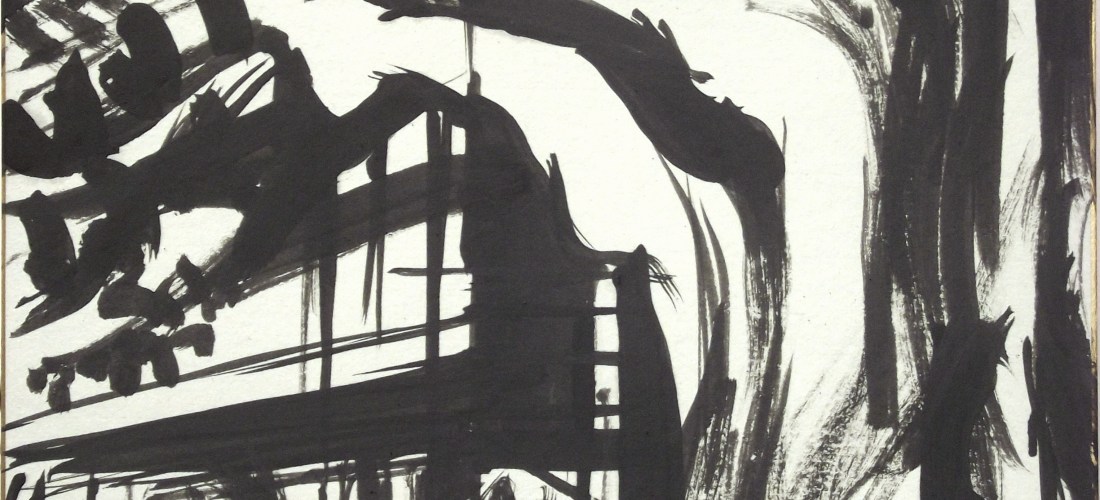
I first made a piece using a structural way of thinking where I could show the scale of the tree and the Art Building behind it. (For UH people this piece of info I found online might be interesting: ‘[this particular] tree was there first, and in fact is the oldest tree on campus. Before the art building, this tree shaded Gilmore Hall, built in 1935 and demolished in 1973.’ Though knowing the time it usually takes a baobab to grow so huge what happened in the past century just seems like an unnecessary detail. 🙂 Also how interesting it is to think about how small we are not just literally, (see featured photo above for scale), but figuratively speaking also comparing us to a wise, old tree like that… [6]) Back to the paintings… I actually used white wallpaint mixed with sumi ink there, which combined the characteristics of the two by being thick and having the ability to cover, also the shade of grey I was looking for. I went out to do some sketches that day with my 9.5 by 10.7 inch-big little cardboards and I just felt there is no way of showing the power of this plant in its full value by making a composition of the full tree on this small piece. This is why I used two different cut-outs on the two paintings I made. One focusing on the crown and one on the trunk. So this occasion was about working in situ. The second one is more sophisticated, aiming to give an impression of the foliage. I used similar technique on another piece also of another tree in the Downtown of Honolulu, that I had done previously.
As it is becoming clearer to me as the time goes by I am unconsciously looking for the circumstances appearing in the late afternoon hours, so the latter baobab version was also done in the same session before sunset. This also means I worked quickly, which is kind of typical for me, with exceptions of course. Still I would say the dynamic fashion of work describes my method quite precisely even if I work on a bigger piece, for a longer time.
Still I feel I will have to revisit the subject matter. 🙂
I hope you like the rich character of this tree.
[1] Hankey, Andrew (February 2004). “Adansonia digitata A L.”. plantzafrica
[2] https://en.wikipedia.org/wiki/Pachycaul, Hungarian version of the Wikipedia article with slightly different content
[3] “Baobab (Adansonia digitata) – Information on Baobab – Encyclopedia of Life”. Encyclopedia of Life. Marie Anne Rolufs, Oregon State University, last download March 4, 2016
[4] Photo of a baobab and the Edina Fulop at Foster Botanical Garden in Honolulu taken by author of cserelatogatohawaiion.blogspot.com, researcher and husband Sandor Gobi, last download Feb 17, 2016 from http://cserelatogatohawaiion.blogspot.com/2016/01/foster-botanikus-kert.html
[5] http://adventureswithben.com/landmarks/giant-baobab-tree/, direct link to video uploaded to youtube, last download March 4, 2016
[6] http://www.edohawaii.com/baobab/uh.html, last download March 4, 2016
[7] http://www.powbab.com/pages/baobab-tree, last download March 4, 2016
[8] http://plantpono.org, last download March 4, 2016
[9] http://www.botany.hawaii.edu, last download March 4, 2016
 @nbfeartist