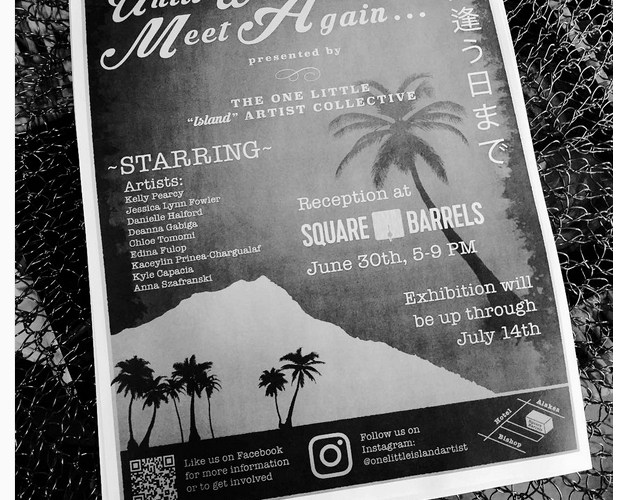
I would like to cordially invite you to a group exhibition I am participating in with The One Little “Island” Artist Collective at Square Barrels. The originally Michigan-based group grew when members moved to Hawaii, still some members currently living on the Mainland or soon-to-be-off-the-island are to be represented at this show also.
My good friend fiber and metalsmith artist Deanna Gabiga introduced me to this colorful, young creative group of people who work in a wide range of media. Deanna—whose work is especially of a truly exceptional kind that is definitely worth getting to know and see in person—and I have a lot in common concerning our interest in different cultures and how our lifepaths brought us to very interesting places of the world. I got to know her as a very talented, driven and clever woman. We have our regular sessions where we consult with each other concerning art, Hawaii and share our experiences and opinions.
I am thankful that on one of our meetings she invited me to exhibit with this group to show a series of my smaller pieces I created during my Artist Residency at University of Hawaii at Manoa during the past academic year. As far as my work, this show in the downtown area of Honolulu can be considered as a little sneak peek of the body of work that will be shown at another two-person show I will soon announce.
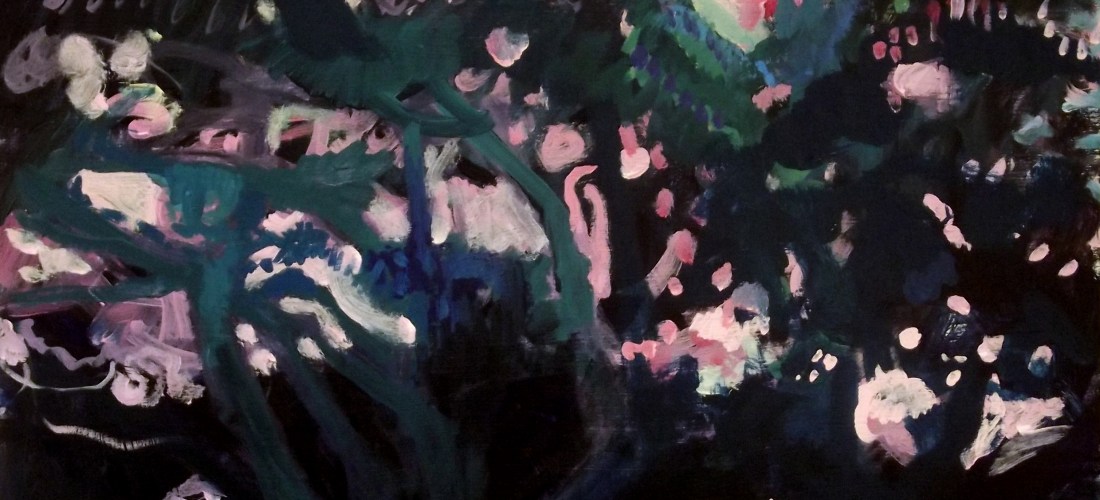
Tree in the downtown of Honolulu, mixed technique on cardboard, 9.5″ x 10.7″, Honolulu, 2016
The Tree which looks particularly beautiful in the sunset III, ink, acrylic on cardboard, 9.5″ x 10.7″, Honolulu, 2016
The Tree which looks particularly beautiful in the sunset II, ink, acrylic on cardboard, 9.5″ x 10.7″, Honolulu, 2016
The Tree which looks particularly beautiful in the sunset I, ink, acrylic on cardboard, 9.5″ x 10.7″, Honolulu, 2016
Going home from campus, ink, acrylic on cardboard, 9.5″ x 10.7″, Honolulu, 2016
Looking at the view, ink on cardboard, 9.5″ x 10.7″, Honolulu, 2016
Between buildings II, ink on cardboard, 9.5″ x 10.7″, Honolulu, 2016
Between buildings I, ink on cardboard, 9.5″ x 10.7″, Honolulu, 2016
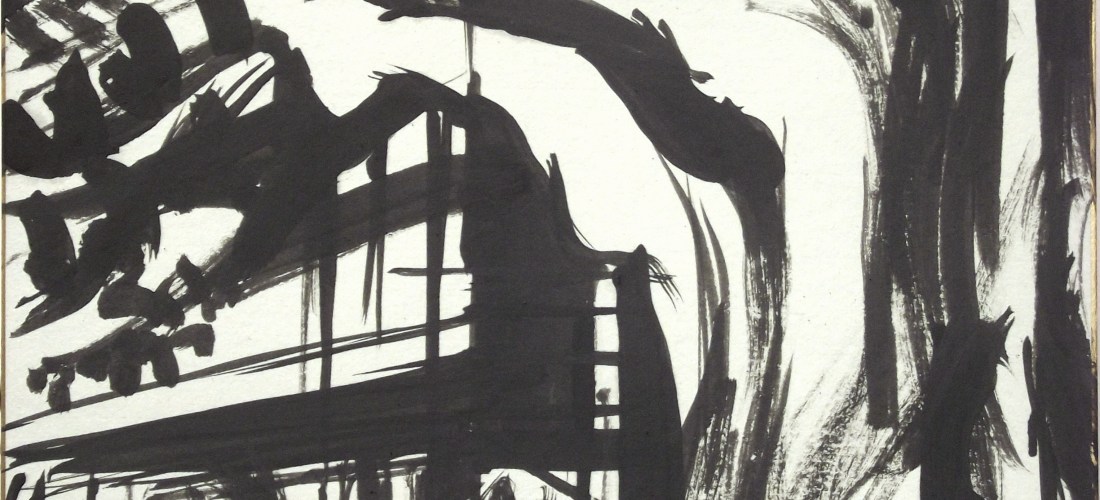
Tree in Honolulu downtown, ink on cardboard, 9.5″ x 10.7″, Honolulu, 2016
The gigantic baobab, ink, acrylic on cardboard, 10.7″ x 9.5″, Honolulu, 2016
The gigantic baobab – approach I, ink, acrylic on cardboard, 9.5″ x 10.7″, Honolulu, 2016
Olive tree on campus, ink, acrylic on cardboard, 9.5″ x 10.7″, Honolulu, 2016
———- 000 ———-
The One Little “Island” Artist Collective presents:
“Until We Meet Again”
The What: an art exhibition featuring ten artists based in
Hawaii and continental US.
The Where: Square Barrels in downtown Honolulu, Hawaii
1001 Bishop Street in Bishop Square.
The When: opening reception on June 30th, 5pm-9pm,
with exhibition running through July 14th.
This particular tree is listed as exceptional tree on the UH plantmap and it is exceptional indeed. 🙂
As the different names suggest, ‘the baobab tree is steeped in a wealth of mystique, legend and superstition’. [1] ‘Baobab is capable of providing shelter, clothing, food, and water for human inhabitants and animals of the African Savannah regions. The cork-like bark or huge stem is fire resistant and is used for making cloth and rope. The leaves are used as condiments and medicines. The Baobab fruit, sometimes called ‘monkey bread’, rich in vitamin C and eaten by African locals.’ [1] [7]
The trunk of this giant, native to Africa, ‘tends to be bottle-shaped and can reach an impressive diameter of 10-14 m and the tree can reach a height of 25 m, the height of a 5 story building.’ [3] Meaning the examples below may be even huge for this species, still the smallest one is enormous too. 🙂
The captions for the pictures in the album below describe a lot more interesting, visually more easily comprehensible info of the plant and after some scrolling you may read a little about my work method also.
Baobab in Africa suggesting why the plant is also named ‘upside-down tree’, hence the rootlike branches [3]
A shot of the edible ripe fruit of this plant, which explains the ‘monkey-bread tree’ naming [1]
‘The fruit can be up to 25 centimetres (10 in) long and is used to make a drink’ [2] [3] ‘The scientific name Adansonia refers to the French explorer and botanist, Michel Adanson (1727–1806), who discovered it in 1749 on the island of Sor, Senegal.’ [6] On the nearby Îles des Madeleines Adanson found another baobab, 3.8 m in diameter, which bore the carvings of passing mariners on its trunk dated as early as the 1444. (…) Adanson concluded that the baobab, of all the trees he studied, >>is probably the most useful tree in all.<< He consumed baobab juice twice a day, while in Africa. He remained convinced that it maintained his health for him.[7]
‘>>Digitata<< refers to the digits of the hand. The baobab's compound leaves with normally five (but up to seven) leaflets are akin to a hand.’ [1] Adansonia digitata – Baobab Tree, Dead-rat tree, Monkey-bread tree, Upside-down tree or Gorakha Chinch in Sanjeevaiah Park, Hyderabad, India [2]
its pretty flower [1]
the fruits of the baobab which in my understanding are responsible for the naming ‘dead-rat tree’ 🙂 [3]
another example for rat-resembelance 🙂 [7]
nice shots of baobabs [7]
another example for the baobab [7]
Let me also show you a little fun intro video on the 6000-year-old (no mistake with number of zeros!) largest baobab ever, located in South Africa, which also has some specialty worth discovering! 😉 [5]
As for the way I approached this gigantic tree…
The gigantic baobab – approach I, ink, acrylic on cardboard, 9.5″ x 10.7″, Honolulu, 2016
The gigantic baobab, ink, acrylic on cardboard, 10.7″ x 9.5″, Honolulu, 2016
Photo of the gigantic baobab / rat tail, which was taken at the same session as I was sitting there painting ‘The gigantic baobab’ right after the ‘first approach’. The photo itself was purely for the sake of being able to show this particular tree objectively.
I first made a piece using a structural way of thinking where I could show the scale of the tree and the Art Building behind it. (For UH people this piece of info I found online might be interesting: ‘[this particular] tree was there first, and in fact is the oldest tree on campus. Before the art building, this tree shaded Gilmore Hall, built in 1935 and demolished in 1973.’ Though knowing the time it usually takes a baobab to grow so huge what happened in the past century just seems like an unnecessary detail. 🙂 Also how interesting it is to think about how small we are not just literally, (see featured photo above for scale), but figuratively speaking also comparing us to a wise, old tree like that… [6]) Back to the paintings… I actually used white wallpaint mixed with sumi ink there, which combined the characteristics of the two by being thick and having the ability to cover, also the shade of grey I was looking for. I went out to do some sketches that day with my 9.5 by 10.7 inch-big little cardboards and I just felt there is no way of showing the power of this plant in its full value by making a composition of the full tree on this small piece. This is why I used two different cut-outs on the two paintings I made. One focusing on the crown and one on the trunk. So this occasion was about working in situ. The second one is more sophisticated, aiming to give an impression of the foliage. I used similar technique on another piece also of another tree in the Downtown of Honolulu, that I had done previously.
As it is becoming clearer to me as the time goes by I am unconsciously looking for the circumstances appearing in the late afternoon hours, so the latter baobab version was also done in the same session before sunset. This also means I worked quickly, which is kind of typical for me, with exceptions of course. Still I would say the dynamic fashion of work describes my method quite precisely even if I work on a bigger piece, for a longer time.
Still I feel I will have to revisit the subject matter. 🙂
I am unbelievably happy I can announce my Artist Residency at University of Hawaii at Manoa being extended until the very end of May which turns my stay here into a roughly 8 month-long paradise in a professional sense. 🙂
This means I can use this fabulous opportunity to continue my own research as an artist, use my studio (#204, Art Building), get to know these talented Honolulu-based artists (whose artistic work and activity as professors, lecturers are both deeply inspiring) and widen my pedagogical experiences by having classes over my studio.
It would all not be possible without the help and support of the Art Department, primarily conceptual artist and head of the department Gaye Chan! I would like to thank also the faculty for being so open, cooperative and supportive!
My studio occupancy started on Oct 5 2015 and, according to the latest notification I received, lasts until May 31, 2016.
The description of the UHM Plant Project can be found under Plant Project Formulating. Each post will discuss one species showing a gallery about the particular tree or trees who served as the models for my artwork. Other photos and the art reproductions are to be presented with descriptive captions aiming to help get to know the personality of these creatures and tell a little bit about my artistic approach to them.
Let me introduce you to the gorgeous couple of uhm. 2371 & uhm. 2370!
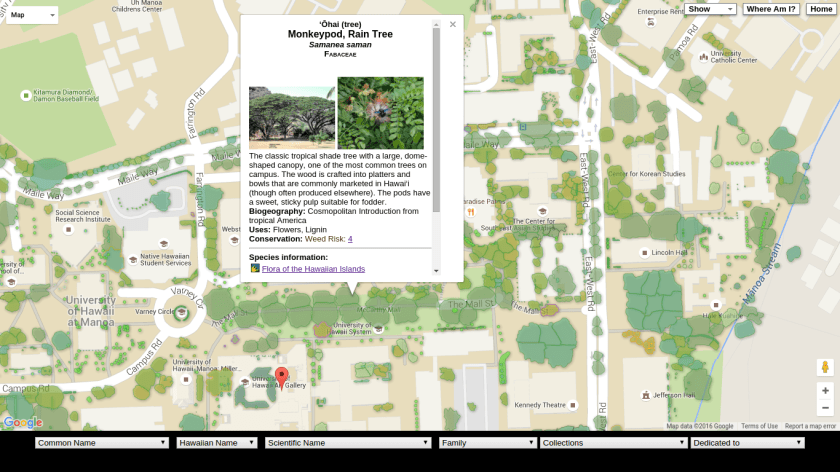
UHM Plantmap, showing the location of my studio also pointing at the monkeypod which is the right one on the artworks I made
Art & process
This photo of these particular monkeypods I took much later than creating my pieces of artwork, only for the sake of objective description here in this post.
This one was one of the many photos that were very much affecting my works.
It is another example which shows how much I do not intend to make ‘great photography’ but aim to make documentation which focuses on one particular aspect. Here obviously the photo is very light, giving me all the detailed information I needed about the disposition of the leaves and branches, even in the darker areas, which could not be seen on some other photos.
A couple of adorable monkeypods at University of Hawaii at Manoa, acrylic on masonite, 23″x23″, 2015, Honolulu
A couple of adorable monkeypods at University of Hawaii at Manoa (study), charcoal on paper, 34″x38″, Honolulu, UH Manoa, uhm. 2371 & uhm. 2370, 2015
An example for the use of these photos taken by the camera of my phone (actually hanging on the wall of my studio). Sometimes I mix them up a little bit with adding something, cutting something etc.
This first gallery of pictures show one particular couple of monkeypods on UH at Manoa. On each of these pictures the ones on the left can be identified by Plant ID: uhm. 2371, the one on the right, by Plant ID: uhm. 2370, which pieces of information also suggests that I was looking to the West when taking these photos, wandering around, trying to catch the greatest moment of sunset.
In this case, I was not sitting there making neither the painting nor the charcoal drawing (as that is also part of my process other times), but took photos for a few days around the same time. I used several different settings for the camera of my phone, and recorded voice notes to myself about how I imagine the future artworks representing them (giving myself instructions to pay attention to some specific details concerning colors, shapes and how these interact / how these two lovely trees interact with each other, what kind of illusion they give).
So having all these footage, each piece of it showing a particular aspect (a detail, a contrast of tones, a color set) of these trees, helped me create my interpretation in which I needed to make the charcoal first. Actually at the time, I felt like I need to loosen up a little bit in my expression, and so this pre-existing intention shows on this drawing above.
As for the painting, after a little time has passed, now I would say, it also must have had a slight influence on me that I found the books Wassily Kandinsky: Life and Work by Will Grohmann and Frank Kupka; pioneer of abstract art by Ludmila Vachtová. Around the same time the NEW NEW YORK: ABSTRACT PAINTING IN THE 21ST CENTURY has just been opened in the UH Art Gallery. The show itself and talks related to the exhibition discussed the variety of abstract paintings, and how it is obviously not a matter of a right or wrong path, to work on abstract or figurative artworks; also questioning if these are relevant terms in our post-postmodern world today anyhow. These thoughts were running through my head at the time.
the books I am grateful – to the so-called FreeStore at UHM – for
In this second gallery pictures of this tree type may be found, and visual info in order to get to know them.
Fun to know about this tree:
“The Rain Tree (…) is a large ornamental tree which can reach a height of 25 meters and a diameter of 40 meters (…). It has a thin, symmetrical, spreading crown which is beautiful in any park or garden setting (…) or as a pot plant (…).
The tree does cast shade (…), but rain can fall through its leaves on the area beneath the crown. This allows grass and other plants to grow up to its trunk (…) and makes for better landscapes. In contrast other trees often prevent rain from reaching the ground beneath their crowns and the result is unsightly bare soil.”
For interesting info on the beautiful structure of the monkey pods, I checked out this description of the Maui Woodworker’s Guild.
— o —
Thank you, Roxanne Adams and David Strauch for the support, for your fabulous work at BGM in general and for your the cooperation! I would like to encourage everyone to comment below to improve the post and help me be accurate on the information I provide!
— o —
Sources listed as hyperlinks in the text and captions. A Plant Vocabulary is listed in a frequently updated post containing words which I needed when reading more detailed descriptions of these trees.
When getting in a new environment, as an artist, I immediately look for motives; practically a source from where I can get inspiration on a quite regular basis. Moving to Honolulu gave me the chance to explore the plant life of Oahu. Being an artist-in-residence at University of Hawaii at Manoa, I was introduced to the Buildings and Grounds Management – Campus Landscape and since I got to know that the so-called ‘plant people’ (who work for BGM) are one of the nicest, some kind of a cooperation is being formulated.
For this reason I am about to sort my artwork from the point of view of the particular individual plants who I make the portraits of. I plan to associate the exact tree with my work by the plant ID number that is used on the plantmap.
Soon new posts are to be published including photos with info about my models. 🙂
Thank you, Roxanne Adams and David Strauch for the support!


![Baobab in Africa suggesting why the plant is also named 'upside-down tree', hence the rootlike branches [3]](https://i0.wp.com/nbfeartist.com/wp-content/uploads/2016/03/07742_580_360.jpg?w=276&h=276&crop=1&ssl=1 "07742_580_360")
![A shot of the edible ripe fruit of this plant, which explains the 'monkey-bread tree' naming [1]](https://i0.wp.com/nbfeartist.com/wp-content/uploads/2016/03/adansondigit2.jpg?w=276&h=276&crop=1&ssl=1 "adansondigit2")
!['The fruit can be up to 25 centimetres (10 in) long and is used to make a drink' [2] [3] 'The scientific name Adansonia refers to the French explorer and botanist, Michel Adanson (1727–1806), who discovered it in 1749 on the island of Sor, Senegal.' [6] On the nearby Îles des Madeleines Adanson found another baobab, 3.8 m in diameter, which bore the carvings of passing mariners on its trunk dated as early as the 1444. (...) Adanson concluded that the baobab, of all the trees he studied, >>is probably the most useful tree in all.<< He consumed baobab juice twice a day, while in Africa. He remained convinced that it maintained his health for him.[7]](https://i0.wp.com/nbfeartist.com/wp-content/uploads/2016/03/baobab_frucht.jpg?w=276&h=276&crop=1&ssl=1 "Baobab_Frucht")
!['>>Digitata<< refers to the digits of the hand. The baobab's compound leaves with normally five (but up to seven) leaflets are akin to a hand.' [1] Adansonia digitata - Baobab Tree, Dead-rat tree, Monkey-bread tree, Upside-down tree or Gorakha Chinch in Sanjeevaiah Park, Hyderabad, India [2]](https://i0.wp.com/nbfeartist.com/wp-content/uploads/2016/03/adansonia_digitata_baobab_tree_in_hyderabad_w_img_8271.jpg?w=276&h=276&crop=1&ssl=1 "Adansonia_digitata_(Baobab_Tree)_in_Hyderabad_W_IMG_8271")
![its pretty flower [1]](https://i0.wp.com/nbfeartist.com/wp-content/uploads/2016/03/adansondigit3.jpg?w=276&h=276&crop=1&ssl=1 "adansondigit3")
![the fruits of the baobab which in my understanding are responsible for the naming 'dead-rat tree' :) [3]](https://i0.wp.com/nbfeartist.com/wp-content/uploads/2016/03/50607_orig.jpg?w=276&h=276&crop=1&ssl=1 "50607_orig")
![another example for rat-resembelance :) [7]](https://i0.wp.com/nbfeartist.com/wp-content/uploads/2016/03/bfcs_6-001_large.jpg?w=276&h=276&crop=1&ssl=1 "bfcs_6-001_large")
![nice shots of baobabs [7]](https://i0.wp.com/nbfeartist.com/wp-content/uploads/2016/03/img_8576_large_large.jpg?w=276&h=276&crop=1&ssl=1 "IMG_8576_Large_large")
![another example for the baobab [7]](https://i0.wp.com/nbfeartist.com/wp-content/uploads/2016/03/bfcs_12-001_large.jpg?w=276&h=276&crop=1&ssl=1 "bfcs_12-001_large")




 @nbfeartist